Business
UAE Civil Code 2026: what businesses must change
Federal Decree-Law No. 25 of 2025 took effect on 1 June 2026. Key changes to negotiations, penalties, hardship and limitation periods.
Contact us

Overview
On 1 June 2026 the UAE’s new Civil Transactions Law — Federal Decree-Law No. 25 of 2025 — came into force, replacing the civil code that had governed contracts in the Emirates since 1985. It is the largest overhaul of UAE contract law in four decades, and it is not a cosmetic renumbering: the new code changes how negotiations create liability, how courts treat agreed penalties, and when a party can escape a contract that has become ruinous.
One scoping note before the detail: the new code governs onshore UAE. The DIFC and ADGM financial free zones run their own common-law systems, so contracts anchored there follow a different track.
What changed
The 1985 Civil Transactions Law is gone in full, replaced by a modern code that touches every stage of a contract’s life — from the first negotiation to the last limitation deadline. The headline shifts for businesses: pre-contract duties now carry liability, judicial control of agreed penalties is written into the statute, hardship relief can no longer be contracted away, and electronic contracting finally has a clear footing.
“The most underrated change is the quietest one: limitation periods switched to the new code on day one, including for existing claims. A receivable you were planning to "get to eventually" may now be on a shorter clock — that is the first thing we check in every client’s portfolio.” Gennady Kurdiumov Senior Partner, Co-founder
Negotiation duties
The most conceptual change sits before the contract even exists. The new code codifies a duty to negotiate in good faith: walking away from advanced negotiations in bad faith can now create liability, although the compensation by default does not extend to lost profits or lost opportunity unless the parties agreed otherwise.
Paired with it is a statutory duty of disclosure: each side must reveal information of decisive importance to the other side’s consent — and a contractual waiver of this duty is void. Deliberately staying silent about a material fact that affects the validity of the deal is treated as bad faith.
For deal practice this means three habits become protective rather than bureaucratic: keeping a record of how negotiations progressed, being deliberate about what is disclosed and when, and writing term sheets and letters of intent with the understanding that the pre-contract stage is no longer a liability-free zone.
Agreed penalties
Liquidated damages clauses — fixed compensation amounts agreed in advance — have always been subject to judicial adjustment in the UAE. The new code writes the grounds directly into the statute: a court may reduce the agreed amount if the debtor shows it was clearly excessive or the obligation was partly performed, may reduce it where the creditor contributed to the loss (and refuse it entirely where the creditor’s fault substantially outweighs the debtor’s), and may award more than the agreed figure where the breach involved fraud or gross fault. None of this can be contracted out — an agreement to the contrary is void.
The practical consequence: an agreed-damages figure is a starting point, not a ceiling or a floor. Clauses drafted as genuine pre-estimates of loss, with the reasoning documented, will survive scrutiny far better than round numbers chosen for deterrence.
“Under the new rules we advise clients to treat every agreed-damages figure as something they may one day have to justify to a judge: keep the calculation behind the number, revisit it when the contract is amended, and expect adjustment in both directions where fraud or gross fault enters the picture.” Gennady Kurdiumov Senior Partner, Co-founder
Hardship and impossibility
Under the old law, a party crushed by exceptional and unforeseeable circumstances could ask the court to reduce an obligation that had become excessively onerous. The new code goes further: the court may now also terminate the contract where reduction is not enough. This protection is mandatory — it cannot be excluded by agreement.
For long-term supply, construction and joint-venture arrangements, this shifts how risk should be priced. If a contract cannot bar the hardship route, the sensible response is to design it: price-adjustment mechanics, renegotiation triggers and clear allocation of specific risks give the court less reason to intervene on its own terms. Contracts for works get their own version of the rule, allowing time extensions, price revision or termination even in lump-sum structures.
Force majeure remains distinct: where performance becomes impossible rather than merely onerous, the obligation is extinguished and the contract terminates — in full or in the affected part.
Smaller changes
- Electronic contracting is fully recognised. Offer and acceptance through electronic communications and conduct-based acceptance now have clear statutory footing, and framework agreements get a defined statutory regime for series of future transactions under agreed core terms.
- Choice of law has a firmer basis. The code expressly recognises the parties’ freedom to choose the governing law; absent a choice, default rules point to the parties’ common domicile and then the place of performance.
- Guarantors gained a shield. Unless liability is joint, a creditor can no longer go straight to the guarantor: the guarantor may insist that the principal debtor and the debtor’s assets be pursued first.
- Abuse of rights is tested for proportionality. Exercising a formal right in a way that inflicts disproportionate harm on the other side is easier to challenge.
- Housekeeping updates. The age of legal majority moves to eighteen Gregorian years, and the window for claims over hidden defects in goods extends from six months to one year.
Some provisions of the 1985 law were simply not carried over — including, among others, the old articles on wagering — with those areas left to dedicated regulators and special legislation.
Old contracts
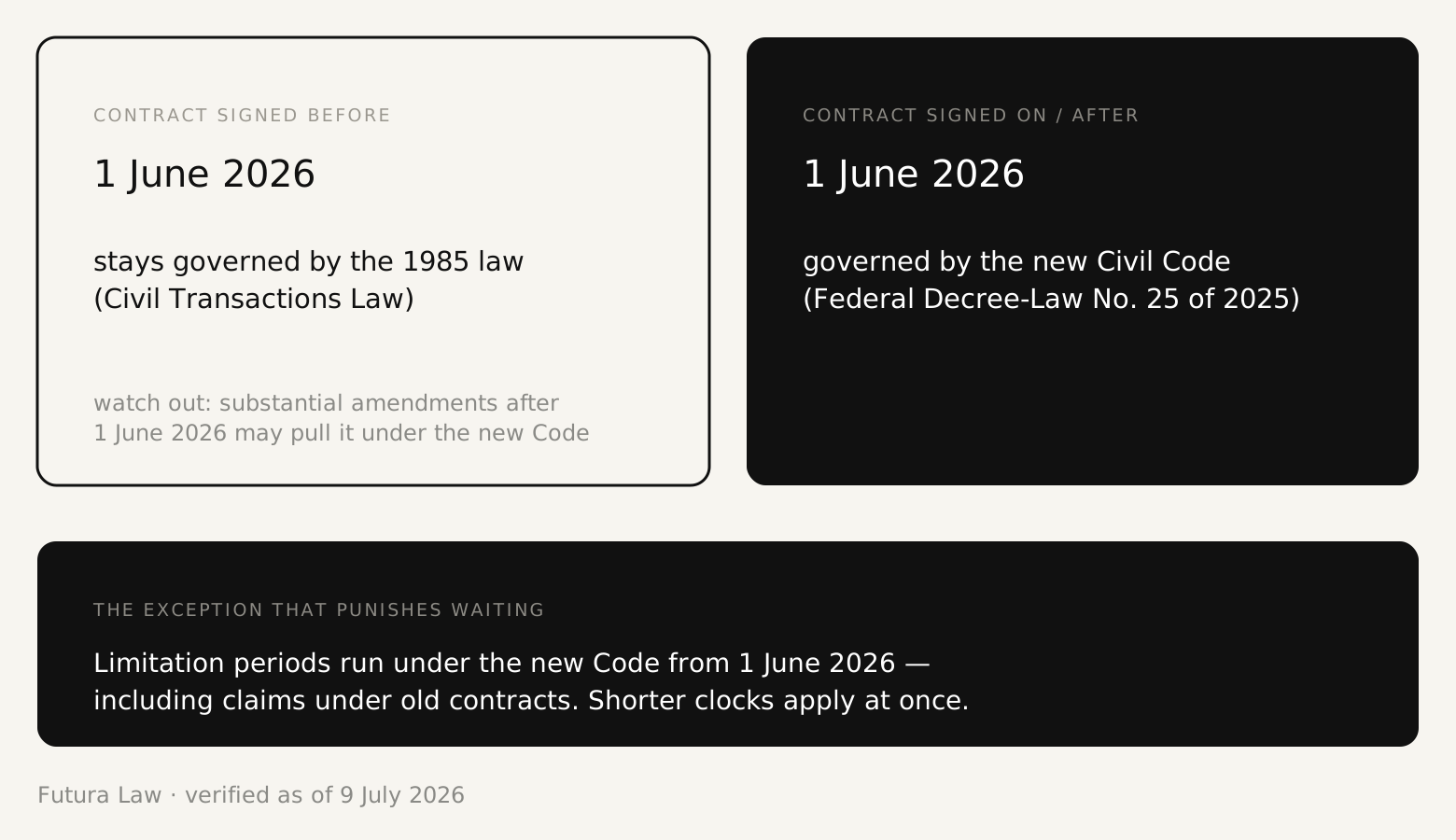
The default transition rule is reassuring: the new code does not apply retroactively, so a contract signed before 1 June 2026 continues to live under the 1985 law.
The loud exception is limitation periods. Prescription periods that had not expired by 1 June 2026 are governed by the new code from that date onward — and where the new law sets a shorter period, it runs from the commencement date. In plain terms: a claim you assumed had years of runway may now be on a shorter clock, and this applies to existing disputes and receivables, not just future ones.
Two further wrinkles deserve attention. Evidence is assessed under the rules in force when it was, or should have been, prepared. And there is a genuinely open question about contracts that are amended or extended after 1 June 2026: a substantial amendment may pull an old contract, in whole or in part, under the new regime. Until courts speak, prudent drafting treats every post-June amendment as a chance to state expressly which law the parties intend to govern.
Action plan
- Sort the portfolio by date. Split contracts into pre- and post-1 June 2026, and flag anything long-term that will likely be amended or extended — those are the documents where the applicable-law question becomes live.
- Audit limitation periods first. The switch applies immediately to unexpired claims. Any receivable or dispute sitting in the drawer should be re-checked against the new clocks before a strategy assumes there is time.
- Re-justify agreed damages. Review liquidated-damages clauses as genuine pre-estimates, document the reasoning, and expect adjustment in both directions.
- Re-price long-term risk. With hardship relief now mandatory and extendable to termination, add renegotiation and indexation mechanics rather than relying on a clause that pretends the doctrine away.
- Tighten negotiation discipline. Records of disclosure and negotiation history are now litigation assets. Update NDA and term-sheet templates with the pre-contract duties in mind.
FAQ
Does the new code apply to my contract signed in 2024? As a general rule, no — pre-June-2026 contracts remain under the 1985 law. But limitation periods on unexpired claims switched to the new code immediately, and substantial amendments after 1 June 2026 may change the analysis for the amended parts.
Can we exclude the hardship rules or judicial adjustment of penalties in our contract? No. Both regimes are mandatory, and agreements to the contrary are void. What you can do is design the contract so the doctrines are less likely to be triggered: adjustment mechanics, documented pre-estimates, allocated risks.
Do DIFC and ADGM contracts follow the new code? The financial free zones operate their own legal systems, so contracts governed by DIFC or ADGM law follow those regimes. The new code matters for them mainly where onshore UAE law applies to a counterparty or an asset.
Is a full re-papering of templates necessary? Not a panic rewrite — but templates touching penalties, hardship, governing law, guarantees and pre-contract documents should be reviewed this year, because those are the areas where the statute overrides drafting habits.
Where can I read the law itself? The official text is published on the UAE legislation portal as Federal Decree-Law No. 25 of 2025 (Civil Transactions Law). Commentary still varies on article numbering — positions should be checked against the official text.

Ready to discuss your project?