What a Company Registration Number Is and How to Find One
September 30, 2026
A company registration number is the identifier a state register assigns to a company at incorporation. It is public, it survives a change of company name, and it is the only field that reliably separates two entities with confusingly similar names. Registers are built around it: search by name and you get a list of candidates, search by number and you get one entity.
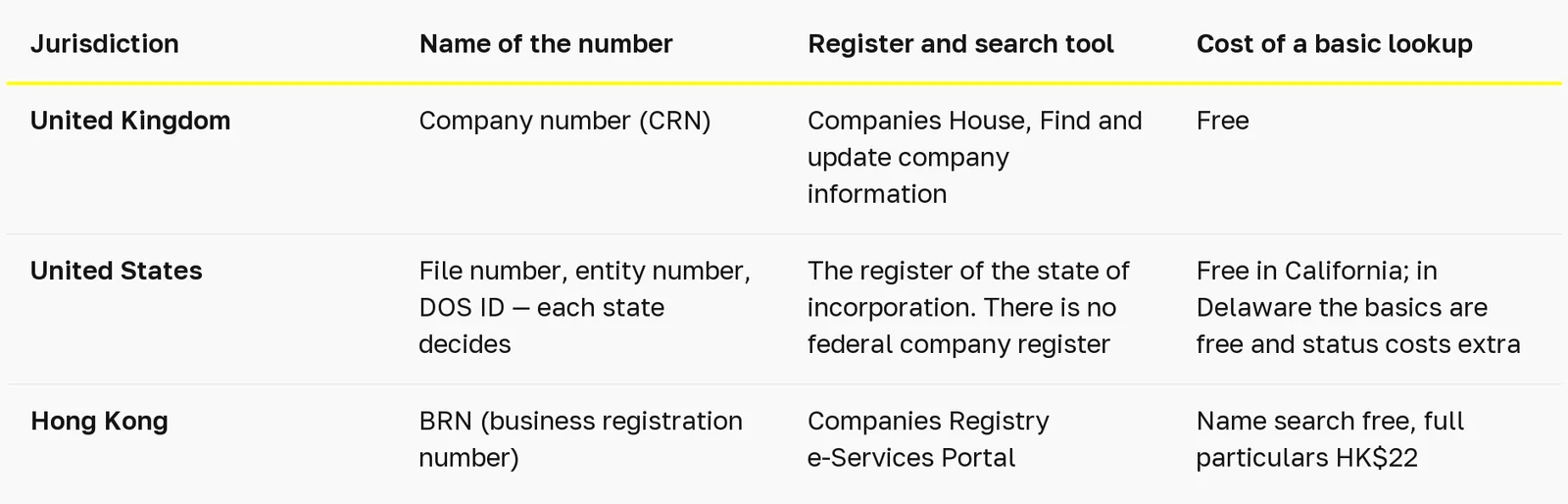
The label changes with the jurisdiction. The United Kingdom calls it the company number, or CRN. Delaware calls it a file number, California an entity number. Hong Kong uses the BRN. The function is identical everywhere: one legal entity, one number, one register entry.
Where to look, by jurisdiction
The numbers people confuse it with
Most of the confusion around registration numbers comes from tax identifiers. They are issued by a different authority, for a different purpose, and they answer a different question about the company.
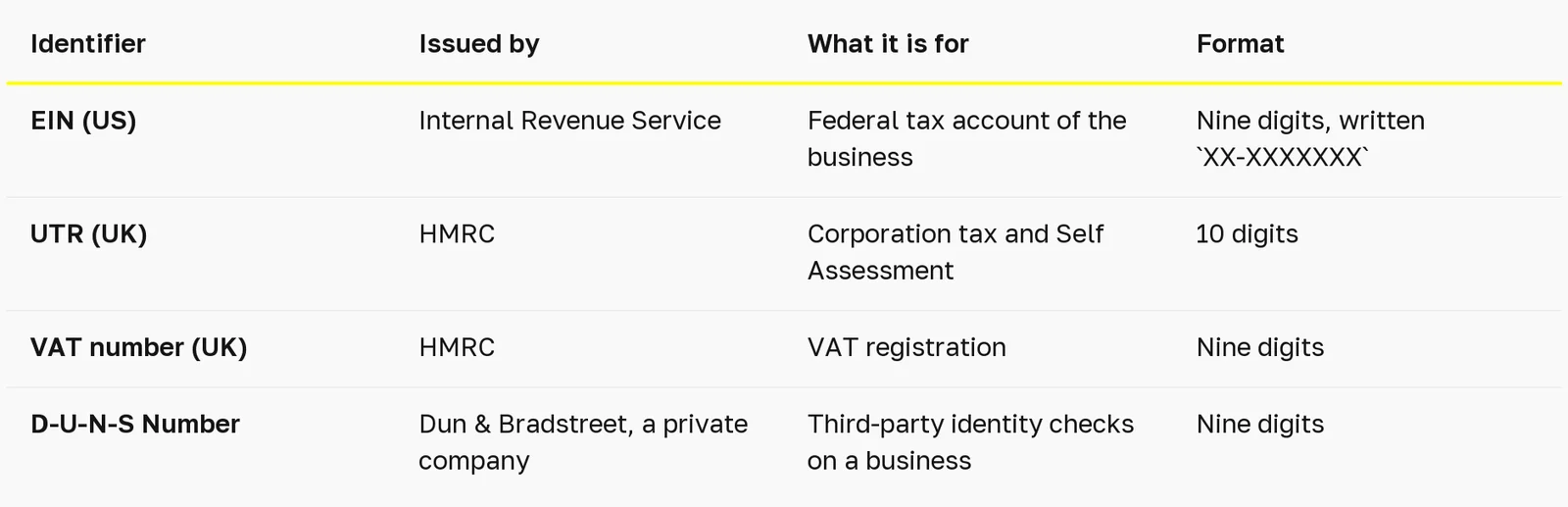
Two of these deserve a closer look.
An EIN is a federal tax ID. It says nothing about where the company is incorporated, the IRS gives the number out only to someone authorised to receive it, and an EIN will not get you into a register lookup. Its first two digits identify the IRS campus that assigned it or the fact that it was issued online.
A D-U-N-S Number is assigned by Dun & Bradstreet, and Apple requires it from companies enrolling in the Apple Developer Program: Apple uses it to check the identity and legal entity status of the organisation. Studios discover this at the worst moment, when the store account is the last blocker before release. D&B may already hold a free number for the entity, and if not, allow up to five business days for D&B to issue one plus two more for Apple to receive it. The registration number does not substitute for it.
What the number looks like in each jurisdiction
United Kingdom: eight characters
The Companies Act 2006 says the registrar allocates a number to every company and that the number takes "such form, consisting of one or more sequences of figures or letters, as the registrar may determine" (section 1066). In practice the CRN is up to eight numerals, or a two-letter prefix followed by up to six characters. Companies registered in England and Wales get eight digits. Of the letter prefixes, the same HMRC manual names `FC`, which goes to an overseas company registered with Companies House in England and Wales.
Leading zeros are part of the number. The register pads short numbers to eight characters, so `6` is stored and displayed as `00000006`, and that is the form to copy into a contract.
Nothing in the Act ties the number to the name. The only route to a new number it provides is the registrar adopting a new numbering format, and even then the old number stays valid for trading disclosures for three years. A rebrand leaves the CRN untouched.
United States: one register per state, and no federal one
This is the part that sends people in circles. A US company is formed under the law of a single state and appears in that state's register. There is no nationwide company register to search. The Small Business Administration puts the practical version plainly: most states require registration with the Secretary of State's office, a Business Bureau or a Business Agency.
The format follows the state, not a national standard. Delaware issues a file number, California an entity number, and the two registers even differ on what they give away for free.
SEC EDGAR is not the missing federal register. It holds documents filed by publicly traded companies and others with the SEC, which leaves out the overwhelming majority of US entities, including nearly every privately held studio.
Teams looking for a US company number lose an afternoon to the assumption that one exists nationally. Start from the state, and the state is a fact about the company you can usually get from the counterparty in one message: ask which state it is incorporated in before you start searching. If they cannot answer that quickly, you have learned something useful about the counterparty.
— Futura Digital's assessment
Hong Kong: the CR number became the BRN
Hong Kong changed its identifier, and any guide written before 2024 will send you to the wrong number.
Until 27 December 2023 a Hong Kong company had a Company Number, also called the CR number. On that date the Companies Registry completed the second phase of the Unique Business Identifier programme, and the BRN became the identifier for companies and entities under the Registrar of Companies. The BRN is the first eight digits of the Business Registration Certificate number, assigned by the Business Registration Office of the Inland Revenue Department. The first phase had already covered limited partnership funds from 1 November 2021.
Three consequences matter in practice:
Where the number is printed on your own documents
If the company is yours, you do not need a register at all.
How to find another company's number in the register
Companies House (United Kingdom)
STEP 1 — Open the register search
Go to find-and-update.company-information.service.gov.uk. The single search box accepts a company name, a company number or an officer name.
STEP 2 — Search by name and read the result line
Each result shows the company name, the eight-character number, the status and the registered office address. Dissolved companies stay searchable: a search for `00000006` returns a life assurance society dissolved in July 2018, number and address included.
STEP 3 — Narrow it down when the name is generic
Use Advanced company search to filter by incorporation date range, registered office address, company status, company type and SIC code. Address plus incorporation year usually resolves a name collision in one pass.
STEP 4 — Take what you need for free
Companies House charges nothing for the register data itself. Free access covers company information such as registered address and date of incorporation, current and resigned officers, document images, mortgage charge data, previous company names and insolvency information.
Delaware Division of Corporations (United States)
STEP 1 — Confirm the state first
Delaware only holds Delaware entities. A company incorporated in California, Wyoming or New York is in that state's register instead.
STEP 2 — Run the entity search
Open icis.corp.delaware.gov/ecorp/entitysearch/namesearch.aspx. It takes either an entity name or a file number, the name field is not case-sensitive, and quotation marks force an exact match. Results include both active and inactive entities, and the Division warns that their appearance "is not an indication of the current status of an entity."
STEP 3 — Read the free fields
At no cost the search returns the entity name, file number, incorporation or formation date, registered agent name, address, phone number and residency, plus entity kind and type.
STEP 4 — Pay only for what the free view omits
Delaware charges $10 per entity for status, or $20 for detail including the current franchise tax assessment and filing history. A certified short-form certificate of good standing is $50, and the long form $175. Current officers and directors sit in the most recent annual report; shareholders are not filed with the Division at all, since the corporation keeps that record itself.
One operational note: the Division "strictly prohibits mining data" and may suspend access for automated or repeated searches. Bulk-checking a partner list needs a different approach.
STEP 5 — Compare against the state next door
California's Business Search gives away more: entity name and number, formation date, current status, addresses, agent for service of process, officer and director names and addresses, and plain copies of filed documents. Same country, same question, different answer. Check the rules of the specific state before you budget for a search.
Companies Registry (Hong Kong)
STEP 1 — Use the e-Services Portal
Search runs through the e-Services Portal, which replaced the old ICRIS Cyber Search Centre when the revamped system launched on 27 December 2023. An account is optional; searching as an unregistered online user works.
STEP 2 — Start from the free searches
The Registry's price guide lists Company Name Search (left partial match or exact name match), Document Index Search, Register of Charges Index Search and Register of Disqualification Orders Index Search as free of charge.
STEP 3 — Translate an old CR number
If your paperwork carries a pre-2024 Company Number, use the "Quick Search > CR No. / BRN Mapping" function to convert it to the current BRN, or the BRN back to the old number.
STEP 4 — Buy the particulars if you need them
A Company Particulars Search costs HK$22 per company. A company-based Directors Index Search is HK$11. Image records of filed documents run HK$9 to HK$29 online depending on document type and account status, and a certificate of continuing registration is HK$170. A registered online user account costs HK$500 a year for the principal account.
STEP 5 — Check whether you are even looking at a company
The Registry's search services cover entities registered under the Companies Ordinance, the Limited Partnerships Ordinance, the Limited Partnership Fund Ordinance and a few related ordinances. A Hong Kong sole proprietorship or partnership holds a BRN from the Business Registration Office without appearing in the Companies Register. For those, the Inland Revenue Department's BRN enquiry service takes the full business name and its location.
If the company is not in the register
Work through these before concluding the entity does not exist.
What the number lets a counterparty verify, and what it does not
This is why the number sits in the signature block of your contracts, in payment provider forms and in every due diligence request list.
What a register lookup gives you, depending on jurisdiction: legal name, registration number, date of incorporation, registered office, entity type, current status, filing history, previous names, charges over assets, insolvency events, and directors or officers.
What it does not give you:
A register check is the cheapest step in diligence and the easiest one to over-read. It confirms that a legal entity exists, is current, and is represented by the people you are talking to. It does not confirm that the entity can pay. When the deal size justifies it, the register is where diligence starts rather than where it stops.
— Futura Digital's assessment
Where this comes up in practice
Signing a contract. The parties clause needs the legal name, the jurisdiction and the registration number. A contract naming a brand instead of a registered entity creates an argument about who owes what before it creates any obligation.
Onboarding a payment provider. Registration number, certificate of incorporation and proof of registered address are standard onboarding documents. A mismatch between the name on the register and the name on the application stalls the file, and in a launch window that is expensive.
Opening a store account. Apple wants a D-U-N-S Number registered to the legal entity, and D&B derives its records from the entity's registration data. If the register shows a name or address that no longer matches reality, fix the register first.
Checking a publisher before signing. Pull the register entry for the exact entity on the term sheet, not the group's marketing name. Confirm it is active, look at the incorporation date against the track record you were told about, and check whether the signatory appears as a director.
Diligence on a partner or acquisition target. The number is the key that ties together tax filings, bank records, IP assignments and litigation searches. Get it wrong at the start and every downstream check looks at the wrong company, which is why legal due diligence opens with the register entry of the exact signing entity.
Group structure is where register checks go quietly wrong. The entity that owns the game, the entity that employs the team and the entity that signs the publishing deal are frequently three different companies in three jurisdictions, and only one of them has assets. Ask for the registration number of every entity in the chain that touches your rights or your money, and confirm each one in its own register.
— Futura Digital's assessment
What to do next
If you are choosing where to incorporate, or the register entry no longer matches the company you actually run, both are fixable. We handle company registration in more than 20 jurisdictions and start from jurisdiction selection rather than from a form, so the entity you end up with is the one your payment providers, stores and investors can work with. The full picture of what sits around it is on our corporate and structuring page.