ADGM's streamlined regime for smaller funds: what falls away and what the switch costs
September 25, 2026
On 16 September 2026 the Financial Services Regulatory Authority (FSRA) of Abu Dhabi Global Market published final rules creating a lighter-touch status for managers of smaller funds: the Sub-Threshold Fund Manager, or STFM. A manager holding it need not appoint a Finance Officer or maintain an internal audit function, and its capital requirement freezes at USD 50,000 instead of climbing with expenditure. For a manager already licensed in ADGM the switch costs USD 1,000 and goes through a single declaration; no new licence is issued. The other half of the answer costs more: the licence narrows, retail and open-ended funds are closed off under the new status, and widening the permission back out runs to USD 5,000.
What the package contains
The amendments landed in five FSRA rulebooks, all in the 16 September 2026 edition: FUNDS VER13.160926, GEN VER15.160926, PRU VER21.160926, COBS VER24.160926 and the glossary GLO VER29.160926. FSRA itself describes the STFM and IFM frameworks as operating with streamlined requirements that recognise the lower risk involved, and its own approach to those two as proportionate and risk-based (guidance, paragraphs 4 and 5). Inside sits a cluster of statuses:
The detail for the STFM, VCFM and IFM regimes sits in Supplementary Guidance — Regulatory Framework for Specialised Fund Manager Categories VER01.160926, issued under section 15(2) of the Financial Services and Markets Regulations 2015 (FSMR), ADGM's financial services statute. It is guidance: the regulator states there that it is not bound by it and may modify it at its discretion.
Who qualifies for which status
STFM manages closed-ended funds whose units cannot be redeemed on demand — Exempt Funds, Qualified Investor Funds (QIFs) or equivalent foreign funds closed to retail. Advising and arranging are allowed on top, limited to co-investments in those funds.
VCFM adds an asset restriction: venture funds only, holding non-traded securities and tokens of early-stage companies (FUNDS 4.1.6). IFM manages only QIFs or equivalent foreign funds with a USD 5 million minimum subscription and no natural persons among unitholders (FUNDS 4.1.10). IFAM manages the assets of institutional funds whose fund manager sits in the same group.
Full scope against streamlined
From Annex 1 to FSRA's guidance. Amounts in US dollars.
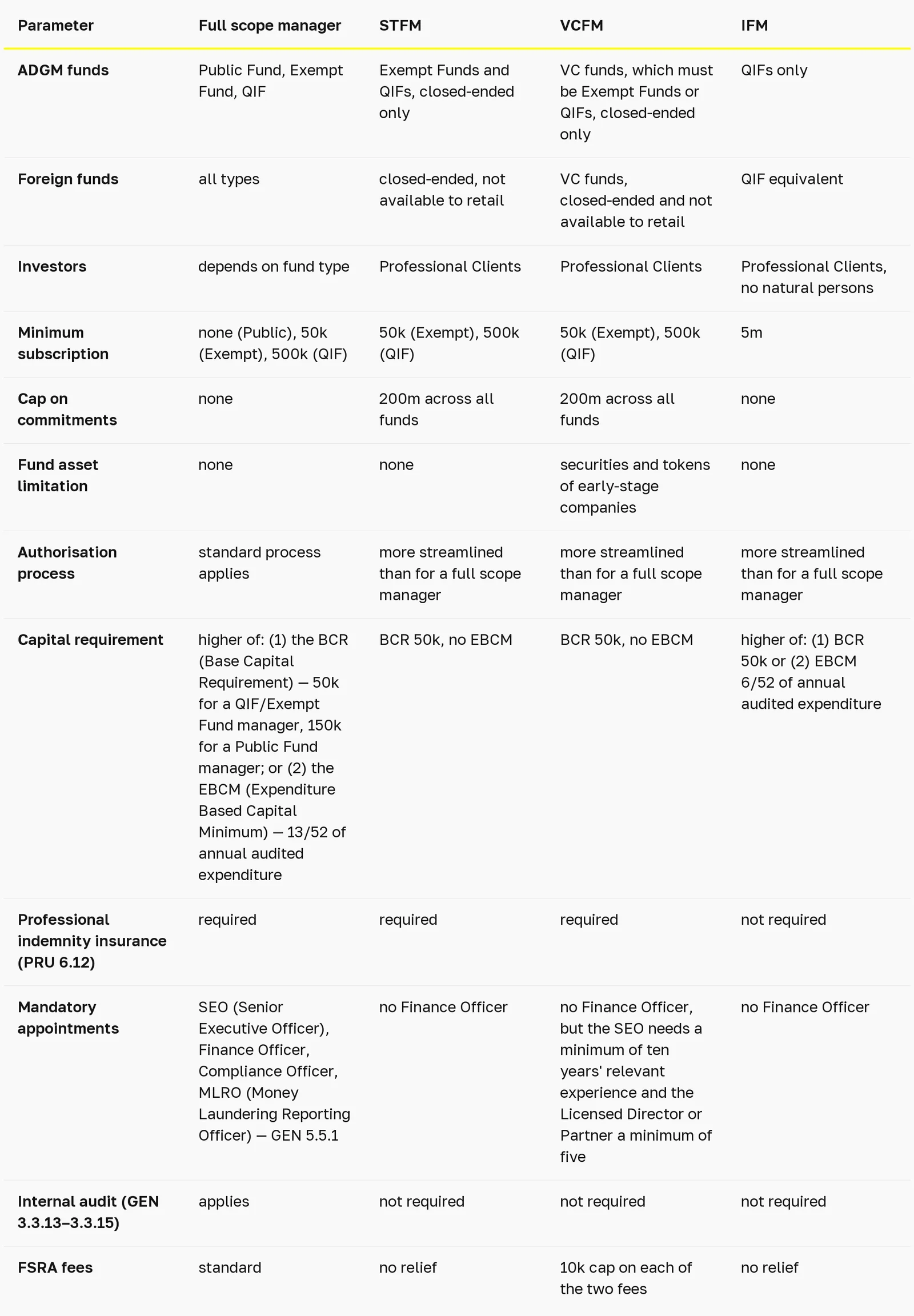
One row cuts against intuition. Professional indemnity insurance is required for an STFM and not required for an IFM — the one point where the small-fund status is stricter than the institutional one.
The benefit calculation: what falls away and what stays
Three items make up the benefit; none sits in the fees.
1. The Finance Officer. A full scope manager must appoint one: an Approved Person the regulator signs off (GEN 5.5.1(1)(b)). For STFMs, VCFMs, IFMs and IFAMs that obligation is lifted (GEN 5.5.1(3)). The relief is partial — the guidance still expects relevant expertise on hand, in-house or outsourced, and the SEO and directors stay responsible for the accounts and capital compliance. What goes is the approved position and its reporting.
2. Internal audit. GEN 3.3.13 to 3.3.15 do not apply to any of the four statuses: no internal audit function need be established or maintained. The exemption sits in the rulebook itself, beyond the guidance. External audit of the fund's statements is untouched.
3. The capital add-on. A full scope manager of a QIF or Exempt Fund holds the higher of two figures: a base capital requirement of USD 50,000, or an expenditure-based minimum of 13/52 of annual audited expenditure, which is exactly a quarter of that base. For an STFM or VCFM the second is switched off and the minimum stays at USD 50,000. The arithmetic is plain: 13/52 overtakes the floor once annual expenditure passes USD 200,000, so a firm spending USD 400,000 a year locks up USD 100,000 on full scope terms and USD 50,000 as an STFM. An IFM keeps an expenditure-based minimum, calculated at the gentler 6/52, exactly six weeks.
What that quarter is a quarter of matters. Annual Audited Expenditure is not the firm's budget and not its running costs in the ordinary sense. Under PRU 3.7.2 it is all expenses and losses of the normal course of business over a twelve-month period, exceptional items excluded, as recorded in the audited profit and loss account, less eight categories: staff bonuses to the extent they are discretionary; the shares of employees and directors in profits, Share Options included, again to the extent they are discretionary; other appropriations of profits apart from automatic ones; shared commissions; fees, brokerage and other charges paid to clearing houses, exchanges and intermediate brokers; expenses already covered by pre-payments; foreign exchange losses; and contributions to charities. The list is condensed here; the exact wording of each item sits in the rule. The base comes from the most recent audited financial statements, and a firm that has not completed its first twelve months uses the forecast budget filed with its application (PRU 3.7.3). A manager who prices the benefit off management accounts will therefore overstate it: with a sizeable discretionary bonus pool, the USD 200,000 threshold arrives later.
Nor is USD 50,000 the whole of the capital tied up. The guidance says plainly that beyond the minimum an STFM remains subject to all other prudential requirements applicable to Category 3C firms, including the duty to hold liquid assets in excess of its minimum capital requirement (PRU 3.7A.1) and professional indemnity insurance. What is released is the gap between the old minimum and the new one, not the whole sum.
We put no dollar figure on the first two: those costs depend on the firm's structure and hiring, and we have no public data to cite. The third is exact in the sense that the formula comes from the rule itself. How exact the input is depends on whether audited expenditure has been computed under PRU 3.7.2 rather than taken off a management budget.
What the switch costs:
The saving lives in the structure of mandatory functions and in the capital tied up. It does not live in the fees, and a calculation promising savings on FSRA charges deserves a second look. Before filing we price both sides: what dropping the functions and the capital add-on releases, and what the narrower licence costs if the fund plans to pass USD 200 million or to open up to retail. Reversing is provided for and priced: widening a permission to serve Retail Clients and amending or removing a licence condition cost USD 5,000 each (FEES 2.1(b) and 2.1(d)). The two do not stack: Rule 2.1(d) applies "other than in accordance with (b) or (c)", so a widening to retail runs under (b) and carries no second fee.
— Futura Digital's assessment
31 March 2027: who that date is addressed to
The FSRA press release does name it: "A transition period will operate until 31 March 2027 in relation to the New Rules applying to Venture Capital Fund Managers (VCFMs) and Foreign Fund Managers (FFMs)." It reads narrowly: the period belongs to venture and foreign managers already in business, so they can bring their arrangements in line with the new rules, and FSRA says it will contact them directly.
For a voluntary move to STFM, IFM or IFAM no deadline appears in the published documents. The press release says managers "may apply to do so by completing this form", with no date; the forms carry none; and the word "2027" appears in none of the five updated rulebooks. The application is filed when it suits the manager.
How long the regulator takes to decide is also unstated — in the rules, the guidance and the forms alike. That absence does not mean supervision works without an internal timeline; it means no public commitment on timing could be found.
What to do next
The benefit calculation is worth doing on a particular firm's numbers, and before any form is filed. How the declaration is filed, who the streamlined status does not suit and what a manager or fund outside ADGM does are covered in the companion piece on the switch. Where the venue is still open, that calculation belongs inside jurisdiction selection: running it once the structure is already registered is too late.