Visas
UAE Blue Visa 2026: eligibility, requirements and application
Who qualifies for the UAE Blue Visa, how the AED 1M and AED 2M thresholds work, which documents ICP asks for, and what remains unconfirmed.
Contact us

Overview
The Blue Visa is the UAE’s 10-year renewable residence visa for people with an exceptional contribution to environmental protection and sustainability — the third member of the long-term residency family alongside the Golden and Green visas. Approved by the Cabinet in May 2024 and piloted in February 2025 with twenty nominated sustainability leaders, direct applications are now available through the ICP portal. This guide covers who qualifies, what the money thresholds actually mean, and — just as important — which widely repeated claims about the Blue Visa have no official confirmation yet.
From approval to applications
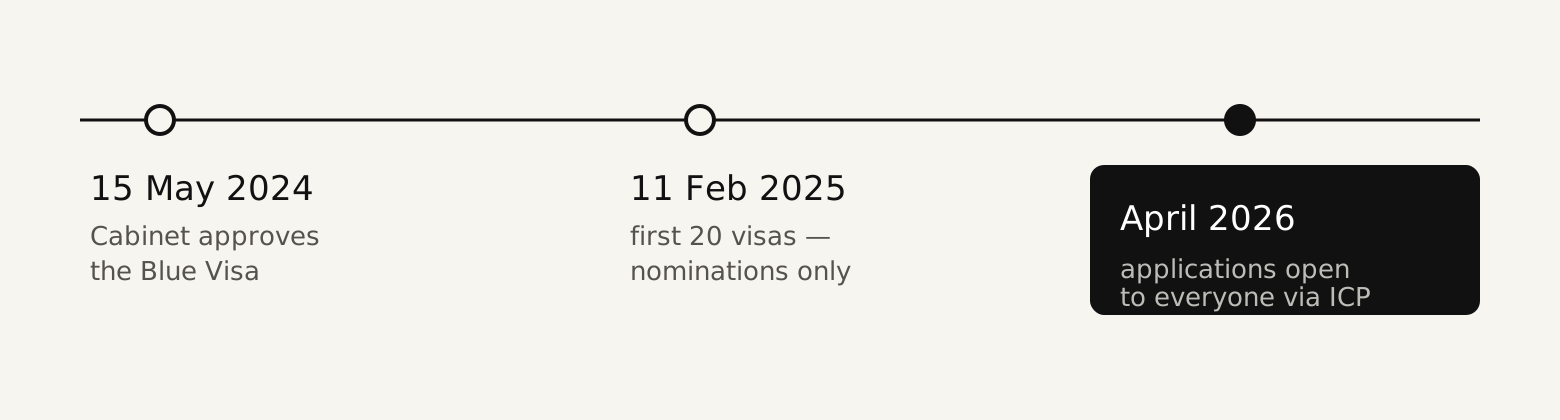
The visa moved in three steps. The Cabinet approved it on 15 May 2024. The first phase launched on 11 February 2025 at the World Governments Summit, when the first twenty visas went to sustainability figures nominated by government bodies — at that stage there was no way to apply on your own. Applications are now available through the Federal Authority for Identity, Citizenship, Customs and Port Security (ICP): an applicant may file directly online or be nominated by a competent authority such as the Ministry of Climate Change and Environment.
That short history matters practically: most of what was written about the Blue Visa dates from the 2024 announcement or the 2025 pilot, and much of it no longer matches how the open application round works.
Who qualifies
The eligibility grid rewards contribution, not just capital. The routes fall into three groups.
Merit routes. Individuals with recognised distinction in environmental work — membership in respected international organisations, major environmental awards, or a documented record of impact. Scientists and researchers qualify through advanced degrees with demonstrated research impact, supported by a letter from the UAE Scientists Council. Holders of patents that serve the UAE’s environmental goals can apply with an official approval letter — from the Ministry of Economy or another competent authority.
Financial routes. Two distinct thresholds exist, and they are often confused. The first: financial support of at least AED 1,000,000 to environmental initiatives approved by the competent UAE authorities — a donation route inside the "distinguished contributors" category. The second: an investment of at least AED 2,000,000 in projects or businesses that advance the UAE’s environmental objectives. The investment must be the applicant’s own capital, with proof of ownership — and, unlike the Golden Visa, there is no real-estate route: buying property does not qualify.
Professional routes. Owners or partners of small and medium businesses in the environmental sector with annual revenue of AED 1,000,000 or more, accredited by the Ministry of Economy or another competent UAE entity; entrepreneurs whose environmental project is endorsed by a UAE-accredited business incubator; and senior specialists working in environmental institutions in the UAE, nominated by their employer.
“Our read of the eligibility grid: the professional and merit routes are underrated. Applicants tend to fixate on the money thresholds, while a documented professional record in the environmental sector — or an employer’s nomination — can be the cleaner path. Before reaching for the chequebook, audit what your track record already proves.” Gennady Kurdiumov Senior Partner, Co-founder
The AED 1M myth
A large share of agency websites present the Blue Visa as something you can buy: "invest a million dirhams, get a 10-year visa". That framing is wrong on two counts. The AED 1M figure is a donation to environmental initiatives approved by UAE authorities, and it sits inside a category that still requires the contribution to be recognised as meaningful — it is evidence of commitment, not a purchase price. And the separate AED 2M investment route requires the money to go into environmental projects or businesses, with documentation to match. Treating either number as a ticket price is the fastest way to a refused application.
How to apply
The process runs through ICP’s smart services (website and app) in two stages: a nomination request first, then — once the nomination is approved — the visa application itself. Applicants outside the UAE receive an entry permit between the two stages. Nominations can also come from government bodies — including the Ministry of Climate Change and Environment, the Ministry of Energy and Infrastructure, and the Office of the UAE Special Envoy for Climate Change.
The documentation depends on the route: award certificates with proof of the awarding organisation’s standing for the merit track, bank statements and donation agreements for the financial tracks, a UAE Scientists Council letter for researchers, accreditation documents for SME owners. Two standing conditions apply to everyone: financial self-sufficiency (you support yourself and your family without state assistance) and valid UAE health insurance covering the holder and dependants.
The current ICP residence-permit card lists an AED 100 application fee, AED 100 for each year of Blue Residence issuance and an AED 100 smart-service fee. A 10-year permit therefore carries AED 1,200 on those three lines; entry permission, status adjustment where needed, medical screening, Emirates ID, insurance, translation and attestation are separate and depend on the file. We confirm the live schedule before payment.
Rights — confirmed and not
The confirmed rights are substantial. The visa runs ten years and is renewable without an in-country sponsor. Family sponsorship is broader than most residence categories: spouse, children regardless of age, and parents receive dependent Blue residency for the same term. Domestic staff can be sponsored, subject to financial capacity — the official rules set no stated cap.
One point is now officially settled, and one still is not:
- Absence from the UAE — confirmed. ICP’s service rules expressly list Blue residency among the categories exempt from the six-month absence rule: holders may re-enter at any time while the residency is valid, the same exemption Golden Visa holders enjoy.
- Work rights — not confirmed. The Blue Visa is a residence status, not a work permit. The prevailing professional reading is that employment will still require separate work authorisation from an employer, as with other self-sponsored residencies. Agency claims of "unrestricted work" have no official source.
The second point is exactly where a ten-year decision deserves legal verification rather than a blog consensus.
“For applicants who qualify for both visas, we frame the choice around two questions: do your parents need long-term residency (the Blue Visa’s family package is broader), and does your capital naturally sit in environmental projects. If the answer to both is no, the Golden Visa’s flexibility usually wins.” Gennady Kurdiumov Senior Partner, Co-founder
Blue vs Golden
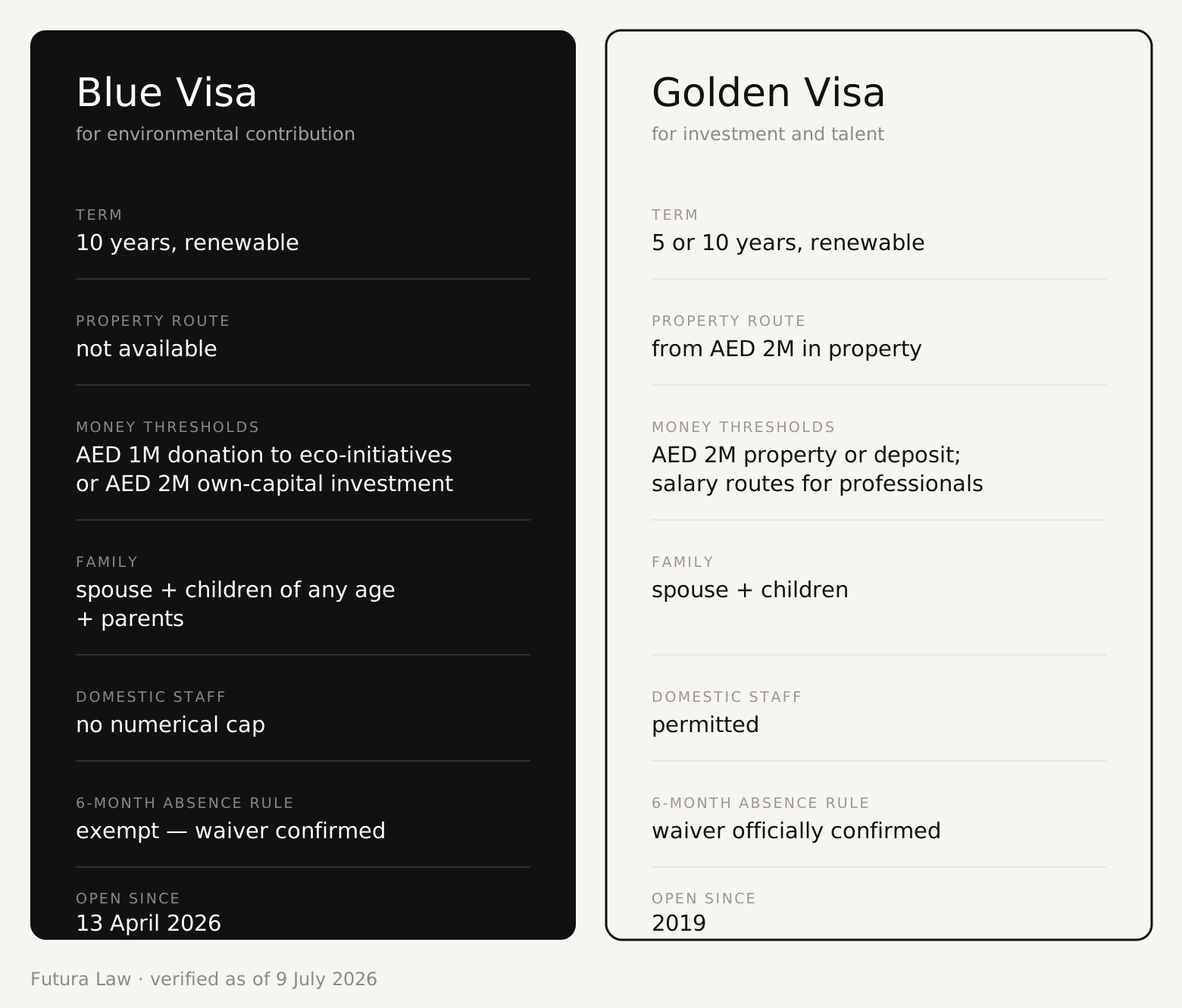
- Term. Blue Visa: 10 years, renewable. Golden Visa: 5 or 10 years, renewable.
- Selection logic. Blue Visa: Environmental contribution and merit. Golden Visa: Investment, talent and professional categories — much broader.
- Property route. Blue Visa: None — real estate does not qualify. Golden Visa: Yes: qualifying property from AED 2M.
- Money thresholds. Blue Visa: AED 1M donation to approved eco-initiatives, or AED 2M own-capital investment in environmental business. Golden Visa: AED 2M property or deposit routes; salary thresholds for professional categories.
- Family. Blue Visa: Spouse, children of any age, and parents as dependants. Golden Visa: Spouse and children; parents not in the standard package.
- Domestic staff. Blue Visa: Sponsorship allowed, no stated cap. Golden Visa: Unlimited helpers permitted.
- Long absence. Blue Visa: the public card does not confirm an exemption; check with ICP before relying on one. Golden Visa: Waiver officially confirmed.
- Application status. Blue Visa: direct filing is currently available through ICP. Golden Visa: 2019.
The family package is the quiet advantage: the Blue Visa is currently the clearest route to ten-year dependent residency for parents. For applicants whose profile fits both visas, that single line often decides the question.
The legal base
No source — official or professional — has published the number of the dedicated Cabinet decision underlying the Blue Visa; public materials rest on the general residency framework (Federal Decree-Law No. 29 of 2021 and its executive regulations). For most applicants this is a technicality. For anyone building long-term plans on the visa — corporate relocation policies, family arrangements — it is a reason to have counsel confirm the current legal position at filing rather than rely on secondary summaries, ours included.
“The application round is young and official processing statistics do not exist yet. Our advice to early applicants is conservative: build the document set to the strictest reading of the criteria, expect the nomination stage to take longer than agency estimates suggest, and treat any promise of a guaranteed timeline as a red flag.” Gennady Kurdiumov Senior Partner, Co-founder
FAQ
Can I get the Blue Visa by buying property in the UAE? No. Unlike the Golden Visa, the Blue Visa has no real-estate route. The financial routes require either a donation to approved environmental initiatives (from AED 1M) or an own-capital investment in environmental projects or businesses (from AED 2M).
Can my parents join me? Yes — this is one of the visa’s distinctive features. Spouse, children regardless of age, and parents can receive dependent Blue residency for the same ten-year term.
Does the Blue Visa let me work in the UAE? It gives you residence, not automatic work rights. Expect employment to require separate work authorisation, as with other self-sponsored visas — and treat any claim of "unrestricted work" with caution until officially confirmed.
How long can I stay outside the UAE without losing the visa? There is no six-month limit: ICP expressly lists Blue residency among the categories exempt from the absence rule, so holders may stay abroad and re-enter at any time while the residency is valid.
I already hold a Golden Visa — can I switch? Yes — ICP officially provides for conversion: existing Golden residency holders who meet the Blue criteria may apply to convert their status, subject to fees. The detailed conditions are assessed case by case.
Where do I apply? Through ICP smart services (icp.gov.ae or the UAEICP app), in two stages: nomination request, then visa application. If you are weighing the wider menu of UAE residence options, our residence visa service covers the standard routes. Government bodies can also nominate candidates directly.

Ready to discuss your project?